This video was put out by 24 Hour Heating & Cooling about their HVAC services offered in the Denver area. If you have problems with your furnace or heating system it is important to call a professional Denver HVAC company to ensure your repairs get done properly and for your safety as well.
Showing posts with label denver heating. Show all posts
Showing posts with label denver heating. Show all posts
Monday, November 1, 2010

Tuesday, September 14, 2010
Cleaning Out Refrigerant

If your air conditioning system suffered major damage, it may be leaking refrigerant, or worse, have foreign particles which can destroy the whole system. Even when replacing refrigerant, it is important to completely evacuate all the old freon. This is because the system is designed to work with only one element inside. Water is a non-condensible gas so when it gets in the system it reduces efficiency until the compressor overheats or some other HVAC part fails.
When installing a new air conditioner or heat pump, the system is always tested for leaks after soldering. The soldering must be tested with pressurized nitrogen. As un-condensible gas gets forced into the condenser by the compressor, it will occupy space used for heat exchange. Even when filling the system or soldering joints, some air comes in. So the system must be evacuated to ensure proper use. You can be sure that any good Denver HVAC contractor will perform this service. It only takes a few hours. Over time a air conditioner with uncompress-able gases in it will fail after operating at high temperatures.
Not only gases, but any moisture will eventually mix with the oil lubricant in the system. As the oil migrates through the system, it becomes and acid sludge. A compressor will not last long in these kinds of conditions. The acid degrades the seals. Instead of just lubricating the interior, it will seep into the electric components of the compressor motor and short it out.
This is one of the most common causes of compressor failing. Unscrupulous HVAC contractors may try and replace the whole system instead of just flushing it, checking for leaks and replacing the compressor. Moisture not only causes electrical components to fail, it also interferes with the operation of the metering device. It can freeze inside the meter and stop it from cooling. As pressure builds up in the system, this is another reason to use refrigerant.
Of course it is not like air conditioners will last forever even with proper maintenance. This is the reasoning behind HVAC warranties. However the big manufacturers want the installer of your Denver air conditioner to be properly trained because proper installation is so important for the total life of the system.
Wednesday, July 21, 2010
Minimizing Central Air Conditioning Bills
People can get hit with a double increase in heating and air conditioning bills as energy costs go up and aging HVAC units work less efficiently. A poorly maintained air conditioner can work at half the efficiency of a well maintained and designed unit. Heating bills are also going up, and many cities now charge energy on a graduated system where each increase in usage is billed at a higher rate. There are some things you can do yourself as a homeowner to increase HVAC efficiency, and some energy-saving steps require the help of a Denver air conditioning company.
The theory behind how cooling works is not all that complex, but trying to make your own adjustments can be hard, especially as Denver HVAC equipment gets more digitized. Even experienced HVAC techs often cannot diagnose cooling problems without the help of many specialized tools.
The steps to be followed on any service are pretty standard. First the technician cleans the coils and checks the refrigerant pressure. The standard checks involve looking at all moving parts and lubricating them. Normally the system should not need to be filled up. With correct sealant it should never lose pressure, however refrigerant fill up are still common.
In central air systems, the heater and air conditioner use the same ductwork. This means there must be a damper to separate the heating and cooling system, so making sure the damper is intact is an important part of minimizing air conditioner bills. Missing dampers waste huge amounts of energy as hot or cool air is dumped into the wrong areas. This is one of the most simple fixes your Denver furnace services company can do.
However regular maintenance and service need not take up all your time. Depending on the part of the country you live in, AC units need to be checked anywhere between every one and five years. If you did have a problem with cooling maintenance you may eventually need to replace an air conditioner.
Usually this will not happen, but if your ac unit is more than 10 years old, or has a poor SEER rating, replacing it may save money in the long term. Although there are many things you can do like fixing duct work, if your system is still hemorrhaging energy after sealing everything up a new HVAC system may be your only option.
Fixing Common Thermostat Problems

Most homeowners have little HVAC knowledge beyond using the thermostat. If your thermostat fails, many people end up calling a Denver HVAC company thinking there is something wrong with their air conditioning equipment when in reality, there is something wrong with the thermostat. When the AC refuses to turn on, it can be hard for someone who is not an HVAC expert to determine if the problem is in the equipment or in the thermostat.
However, before you call a Denver HVAC company, try and follow this troubleshooting guide to see if you can get to the root of the problem. Even more advanced digital and zone-control thermostats really just function as thermometers that switch the HVAC system on and off depending on the temperature. As an electronic switch, the thermostat needs to be hooked up to power in order for it to work and communicate with the heating and air conditioning equipment.
Usually the power for the thermostat comes from the air conditioning unit itself. So any break along this line could cause the thermostat to turn off. You can check the circuit breaker in the air handler or heating split system to see if it has flipped off. Sometimes the handling unit also has a power switch outside the unit that looks like a light switch. Some digital thermostats have two different power sources: battery and wired from the external unit. The batteries power the display, so if the batteries go out, the display stops working but the ac unit does not stop cooling. You can save yourself a lot on calling a Denver air conditioning repair company by simply replacing the batteries. The batteries are there to maintain your programmed thermostat settings in case the power goes out.
If the problem with the thermostat is not the power, it could be the location the thermostat is installed. Except in very advanced models with multiple temperature sensors over the building, most thermostats have the thermometer built in. That means if the thermostat was built into an area that does not represent the air temperature in your home then it will give false readings.
Thermostats with mercury bulbs need to be level to give accurate temperature readings. Heating anticipatory can also get out of whack when not properly calibrated. The anticipatory needs an amp meter in mechanical thermostats to adjust to make sure it properly keeps the blower running past the burner time to get excess hot air out of the ducts.
Air Conditioner Condensing Unit

The air conditioner condensing unit is one half of the cooling cycle with the evaporator coil. The condensing unit's job is to diffuse and reject heat, while the evaporator coil absorbs heat. All HVAC technicians learn this as the first step in their cooling education. The condenser is located in the big boxy exterior unit at most buildings. Heat pumps also use condensers, but most people North of Denver do not use heat pumps because the efficiency of heat pumps decreases as the temperature drops.
The condenser along with the compressor is the main transferor of heat between the outside air and the air blowing through your house. To do this, the compressor must be sealed inside the cooling cycle, and that is why compressor replacements are so common. It is very hard to try and repair something that is sealed within the system. On the other hand, there are many things you can do to try and maintain the life of your condensing unit. If not properly maintained, the condenser and most other air conditioning parts will go into a downward spiral before they self destruct. As the parts become worn and less efficient, the compressor and blower motor will start working harder to try and keep cooling despite reduced ability. Eventually parts overheat and fail.
One thing you can do to maintain your Denver HVAC system to to check the outside cooling unit before summer starts and it is in heavy use. I recommend calling a Denver air conditioner company to perform the check, but if you feel handy and know how to operate around electricity, then go ahead. The first step before doing any work on a condensing unit is to shut of the breaker supplying electricity to the unit. Spin the fan and see if it turns. Then turn on the power and switch on the thermostat and make sure the fan starts blowing upward a good deal. A common problem with these condenser motors is bearing failure, which will stop the fan from spinning properly.
The main reason you want to check the condenser fan motor before you operate the system is because it is connected to the compressor. A failure at the fan can overload the compressor, and the compressor is a much more expensive part than the condenser motor.
Just like evaporator coils, condenser coils can build up dirt and gunk which will decrease efficiency. Just like everything else in central air, as efficiency goes down, the system tries to work harder to compensate until it fails. The solution is to call an air conditioning services Denver company to clean the condenser coils. You can also do it yourself, but you will need to turn the thermostat and breaker off and pull the plug on the condenser electrical box. You will need to spray the condenser with enough pressure to remove dirt without bending the fins. A little soap can help too. The key to maintaining performance with these units is maximizing airflow. So the condenser should be clean and the exterior unit should have clear airflow.
Tuesday, July 20, 2010
Filter Role in Maintaining HVAC Performance

Many homeowners with central heat are unaware that they even need a filter for their HVAC system. The filter cleans the air for two primary reasons: to keep you healthy, and to keep your heating and air conditioning equipment healthy.
For your central air system to work properly, air should easily circulate through the ducts, vents and evaporator coils. All of these parts can become clogged by dirt and other foreign particulate matter. Clogged air works means the compressor and blower have to work harder to push air through the system. They will heat up and eventually work at high energy, sub-optimal cooling modes, then fail. Dust inside the evaporator clings to the moist coils and stops the heat transfer between he air and coil coolant. You can get a recommendation for a good quality HVAC filter from your local Denver air conditioning service company. A poor quality filter will not strain out enough particulate matter to be effective.
These quality air filters also make a big difference on the quality of air you breath in your home. Your filter should stop pollen, dirt, harmful chemicals and allergens from being circulated though your home's Denver HVAC system. Along with the traditional physical filters you can also get electronic air cleaners and electrostatic filters. These offer much more filtering ability and do not need to be regularly replaced.
The electric charge on an electrostatic filter pulls dust to it out of the air. The dust is attracted from a distance, instead of having to get caught up in a tangle of webbing like a traditional filter. A HEPA (high efficiency particulate air) filter is the Denver heating professional's choice when it comes to air filtration. These filters are certified by the Department of Energy as being very effective at removing small airborne particles.
The first filters were created for work on the atomic bomb to stop the spread of radioactive particles. HEPA filters are well used in hospitals and research labs, these filters will stop most airborne viruses, mold and bacteria. Hospital filters may include a ultraviolet light to kill all organisms in the air. Airlines used to be a prime location for the transmission of disease untill HEPA filters were installed. Now airline cabins have lower dangerous organism rates than the average home. Residential HEPA filters are also available and you HVAC company would be happy to help you install one.
Monday, July 19, 2010
Heating Your Home With Solar Energy

One of the cheapest, most environmentally friendly, and efficient ways to heat water is to use solar water heating. A new advance in the HVAC community is solar energy for heating homes. Even in the winter, the sun still bathes the earth with an incredible amount of free energy. The main limitation for solar heating is the climate. In cloudy areas like London, solar heating my not be the best choice. However HVAC in Denver is a great place for home solar energy because of the nearly year round appearance of the sun.
Solar heating is divided into active and passive systems. Passive systems use architecture and smart building design to allow the sun to heat a building. This is not the place for Denver heating companies because passive heating does not use any mechanical equipment.
Active heating collects either heat or solar energy in the form of electricity to heat a house. Then pumps or a HVAC system pushes the heat around the house from the stored heat source. A simple device that can heat a whole house is the non-concentrating flat plate collector. These collectors use a simple plate of some sort of heat-conductive material like metal to absorb solar heat which is then pumped through the house. If your furnace is broken, instead of calling your Denver furnace repair company, consider installing a flat panel solar heat collector. These devices are actually cheap and simple. Not only will you be saving the environment through reduced energy use, but the Denver heating devices pay for themselves after several years of service.
A little more advanced design is the concentrating collector, which uses mirrors or some other device to concentrate all the solar energy to heat a smaller absorbing area. The final and most technically advanced design is using photovoltaic cells to convert solar energy into electrical energy. These systems can be integrated into your house's whole power supply, so it will supply you with electricity for uses other than HVAC.
These solar cells are becoming increasingly efficient and user friendly. A common design has the cells hooked up to batteries to continue to provide power even when the sun is not out. Solar cells create DC current which must be converted to AC to run appliances in the western hemisphere. Any heating device worth the price should be able to continue providing heat at night and on overcast days. Otherwise, you can just use your solar heating device as a supplement, to reduce your energy bills on sunny days.
Controlling Indoor Air Pollution with HVAC Equipment

Pollution within structures is often many times worse than outside because pollutants do not have the whole atmosphere to be diluted in. Especially in manufacturing and heavy industry applications, proper ventilation is necessary to have workers on site. Workers are very vulnerable to indoor pollutants because they will receive continued exposure to them for the duration of their time on the job.
The first step in maintaining proper ventilation in a work environment is to identify all possible pollutant vectors, as well as all the inlet and outlet air ports in a building. Buildings are usually not near air-tight, so harmful fumes can enter or exit from many unusual of locations. Consult with a Denver HVAC company to identify all the natural and man-made ventilation points in your building. Natural points are windows, doors and leaky walls, while man made ventilation points are things like ventilation ducts and blow-off valves.
Not maintaining proper HVAC ventilation puts your company at risk for workplace injury and lawsuits. The first thing a possibly injured worker will do to determine if they are getting sick from improper building ventilation is to leave and see if the symptoms subside. There are a wide range of symptoms and possible indoor pollutants, so it is best to get and idea of what they are and how to address those pollutants from your Denver heating company instead of the local lawyer. Without a vigilant HVAC company or workforce to report problems, many dangerous gases are not noticed until a Denver furnace repair services technician notices something strange. Unfortunately, there are too many stories to count of Denver HVAC techs working in refineries with dangerously inadequate ventilation.
Not controlling these fumes can lead to "sick building syndrome" where workers feel lethargic and sick when at work. In public institutions like hospitals and schools, these symptoms must be taken very seriously because children's immune systems may have less natural ability to fight off toxins. A HVAC system with the central air hooked up to filters and scrubbers will take care of most harmful substances on non-industrial applications.
The major culprits to get people sick inside buildings are: tobacco smoke, burnt combustibles like exhaust smoke, biological pollutants like mold or viruses, volatile organics like solvents and jet fuel, and heavy metals like lead or any other smelter fumes.
How TXV thermostats work


If you are smart and want to save money, you have a programmable thermostat; a thermostat that monitors air temperature and controls heating and cooling digitally. Most Americans however, have an old fashioned thermostat with a wire thermostatic expansion valve. If your thermostat is round or square and says "Honeywell" you are in the same boat with most Americans with their wire thermostatic heating controls.
These thermostats work by monitoring the size of a coiled length of wire. As the temperature increases, the wire expands, and as it decreases, it contracts. Although not the most accurate, these thermostats have been a staple of Denver HVAC for over 50 years. Inside the actual cooling apparatus, there is another kind of thermostat that regulates the equipment. This is a thermostatic expansion valve, or TXV.
Instead of measuring the ambient air temperature, the expansion valve controls the refrigerant as it flows into, and boils out of the evaporator. This split separates the high and low pressure sides of the system. Although still mechanical, the TXV is a little more complex than the Honeywell on the wall, because it must balance three different forces: the bulb pressure trying to open the valve, the spring pressure which tries to keep it closed, and the evaporator pressure, which also forces the valve closed.
All certified Denver air conditioning services technicians learn these forces early on in their HVAC training. With the advent of central air conditioning and heat pumps, many thermostats ore more complex. However the simple thermostatic expansion valve will close if evaporator pressure increases and bulb pressure is stable, and will open if the bulb pressure increases.
Superheat is a Denver air conditioning term that refers to gaseous refrigerant that is still maintaining excess heat. This increases pressure on the bulb, which opens the valve to allow more refrigerant into the evaporator. A problem with your TXV will send your air conditioning out of line because the pressure differential essential to the cooling cycle cannot be maintained if the valve is stuck open or closed. A Denver HVAC technician can identify problems like this relatively quickly. The thermostats come from the factory already calibrated, but the settings may not match your local air conditioner use profile very well.
Tuesday, June 8, 2010
EPA Standards for HVAC Equipment

The majority of the US is in a temperate climate. This means that although the temperature does not reach extremes found in tropical and arctic latitudes, there are major seasonal weather variations. Most Americans choose to use a central air or HVAC system to control interior temperature. For large HVAC jobs like schools and warehouses, the cost of ventilation means that careful planning must go into designing the systems. Average temperatures, energy savings, humidity, local and national codes and indoor air quality are just some of the factors that most be considered on public works projects.
The first step for a large building is using central air handling units, instead of individual ventilators in each room. In some instances like a isolated field house, a unit air conditioner may be a better choice because they take up less floor or roof space. Individual units are harder to maintain in a group and cause other ventilation and moisture problems when combined with a central unit. Central heating is especially popular with teachers because it is quieter and therefore they do not mind using it in the classroom. Denver air conditioning companies installed central heat in Denver high schools over 30 years ago and the system has been a success. Central heat is less prone to drafts because of multiple sources of air. A professional HVAC company can maintain a central unit and tweak the global settings to control humidity.
The consolidated design of central units allow them to be serviced without disturbing the work in a building- and they generally take up less interior space. To meet EPA certification for government buildings, HVAC systems must meet certain requirements. Coils must have sloped non corrosive drain pans to prevent water from stagnating or rusting the system interior. They should be in a wall cabinet with easy access that also reduces sound. This means double wall replacement doors with tight seals. EPA filters are always at least two inches thick. A well designed filter bank will take these high performance filters over a large area for max lifetime. Air filter monitors notify Denver HVAC techs when to replace the filters, as well as any major problems in the system.
To maintain indoor air quality, the easiest solution is to increase air flow from outside. This must be balanced with cost, because to increase air flow, your HVAC system must run longer. The minimum government standard devised by www.ashrae.org is 15 cubic feet/min of airflow per person in schools. Many systems just meet this standard for minimum cost. Energy recovery equipment can minimize the cost from increased ventilation airflow. Energy recovery is popular in Air conditioning in Denver and the east because the technology in this option saves money on large scale HVAC systems.
Tuesday, May 25, 2010
HVAC FAQ

Air conditioners are measured in "tons." A 1-ton HVAC system is the equivalent of 12,000 BTU/H. Depending on the spatial layout of your home and the insulation quality of the house, you can expect every ton to cool between 300 and 800 square feet of space. Although tonnage estimates are good for initial pricing and product research, the only way to know for sure if the system is a good size is to have the home professionally evaluated by a Denver HVAC technician.
"Does an Air Conditioner's "SEER" Value Matter?
SEER stands for "Seasonal Energy Efficiency Rating." Although some air conditioners have simple EER values, seasonal values are more accurate because they measure how efficiently a cooling system will operate over an entire season according to Energy Star, a service of the EPA and U.S. Department of Energy. SEER values are important because a more efficient air conditioner will waste less energy over time, leading to decreased electricity bills. When comparing central air conditioning units, look for a SEER rating of at least 15.
Is Central Heating better than installing a heat pump?
In terms of efficiency, water transfers energy at a much higher rate than air although radiant heat has been found to be more comfortable for the human body than warm air heating from a heat pump. A weak heat pump will generally only heat one room, using fan forced air, where as a central heating system can heat the whole house with a radiator system.
Why Have Your Air Ducts Professionally Cleaned?
Contaminants in your Heating Ventilation Air Conditioning (HVAC) system can aggravate asthma and allergies. Duct Cleaning can help eliminate bacteria and fungus to improve the air quality in your home. Cleaning your air ducts can protect everyone in your home from breathing contaminated air. Cleaning your air duct system can help maintain a cleaner home, requiring less dusting. Cleaning your air duct system helps your HVAC system run more efficiently, resulting in less run time and lower heating and cooling bills. Cleaning your air duct system can also extend equipment life. You should consider having your ducts cleaned if there is substantial visible mold growth or any other physical contaminants inside sheet metal ductwork or on other components of your heating and cooling system.
What should I do if my Pilot Light goes out?
Pilot lights do go out occasionally. Some people even shut them off in the summer. Every homeowner should know how to light his or her pilot so you do not have to call a Denver HVAC technician. It isn't too difficult and there are usually instructions printed on the equipment itself. Many of today's systems don't have a pilot light, they use spark or electronic ignition. Always follow the instructions on the appliance before anything else. Turn off furnace, boiler, or water heater at thermostat or power switch. Locate the gas valve and turn knob to "pilot" position. Hold down the red button, which sends gas to the pilot burner.At the same time hold match to pilot burner. Continue holding button for 60 seconds. Now let go of button, pilot should stay lit. If not, you need to call for service. Turn gas valve knob back to the "on" position.Turn on appliance, turn up thermostat, main gas should light. Remember to put back metal cover if your system had one. If your pilot light goes out more than once a season there could be a problem.
How often should I change my air filters?
For best performance of your system your air filters should be changed every three months although this depends on the conditions in your home. If you have to dust your furniture once a week then you should stick to the quarterly filter changes. You can tell when to change an air filter by inspecting the back side of the filter, any dirt or discoloration on the back side indicates the filter is fully loaded and is releasing dirt into the air stream.
Will a programmable thermostat really save me money?
Generally, as with anything, this depends on how it is used. The more you set the thermostat to adjust the temperature above or below your standard setting, especially when you expect to be out, the more you save. Adjusting the temperature just a couple of degrees while your sleeping will save you money alone but if your home is unoccupied during the day then the savings can be substantial. You can expect a basic programmable thermostat to pay for itself within the first year under the best circumstances and easily within two to three years in circumstances where the adjustments are minimal.
How often should I change my air filters?
For best performance of your system your air filters should be changed every three months although this depends on the conditions in your home. If you have to dust your furniture once a week then you should stick to the quarterly filter changes. You can tell when to change an air filter by inspecting the back side of the filter, any dirt or discoloration on the back side indicates the filter is fully loaded and is releasing dirt into the air stream.
Will a programmable thermostat really save me money?
Generally, as with anything, this depends on how it is used. The more you set the thermostat to adjust the temperature above or below your standard setting, especially when you expect to be out, the more you save. Adjusting the temperature just a couple of degrees while your sleeping will save you money alone but if your home is unoccupied during the day then the savings can be substantial. You can expect a basic programmable thermostat to pay for itself within the first year under the best circumstances and easily within two to three years in circumstances where the adjustments are minimal.
Thursday, May 13, 2010
HVAC tech Motivation

In Colorado, HVAC engineers are members of a unique, specially recognized group. They belong to an international society for all individuals interested in precision climate control. They also conduct social work during the weekend to better the surrounding community. The society specializes in furnace repair in Denver for underprivileged and lower income families. It allows exchange of knowledge and experiences for the benefit journeyman appliance workers in Denver heating repair. They provide many opportunities to participate in the development of Denver air conditioning via, for example, the installation of air conditioning products in single Denver Heating and Air conditioning prides itself on paying union wages.
In lieu of profits some companies promote from within and offer free healthcare benefits with participating providers. In certain states, these courtesies are not extended to the common shop worker in air conditioning and heating profession. However, each employee that is hired for Denver furnace repair undergoes a strict 3-year background check. Local Building Permits are closely followed by Denver Heating contractors in public properties. Members are doused with the flame, which is a corporate tradition in which newly initiated employees are roasted from head to to with a localized propane torch to induce adherence to corporate guidelines. Some HVAC companies are looking at new ways to motivate their workers also offer a critically acclaimed employee assistance program for weigh loss to qualifying Denver Air Conditioning associates who have been with the company for 6 months or more.
One way techs get educated is through case examples and parables of employee behavior. One common education tactic is to take the employee through the refrigeration control system troubleshooting checklist. This is useful more for education, as modern refrigeration boards consist of solid state transistors. In such a case contact your Denver HVAC supplier to get a computer tech on the job. For older systems, this step by step ac checklist is a good confidence builder for air conditioning virgins. No matter how complicated a schematic is, control systems can only have a few outcomes from a given set of parameters. They can control: compressor or condenser fans, evaporator fans, line solenoids, or maintain a desired temperature. Whatever the component is, a great motivating tactic is to trace back the circuit to the switch that controls it. Once the tech sees where everything goes, his HVAC karma will be at one. If a solenoid drops to a set point the evaporator fan will run continuously. This simple solution should be evident once you have a trained HVAC technician.
Monday, May 10, 2010
Building Commissioning and HVAC Certification

Building commissioning is the process of ensuring all building HVAC systems work properly through one year of verification and documentation. Any large commercial HVAC system will need proper commissioning to ensure all systems are safe, working properly, and will pass Denver HVAC certification standards. Systems must work interactively with the owners according to the original design and intent to get this certification. Different jobs may have different levels of commissioning. Originally, the commissioning process was just making sure the building matched the original engineering specifications. Today, especially in socially conscious areas like Denver HVAC systems are often trying to achieve green building standards. Proper design and implementation can now save money as builders are trying to obtain tax breaks and increased sales through Green recognition. Not only in areas of efficiency, building commissioning is now holding contractors to a higher standard in electrical, health and safety systems, as well as overall building structural integrity. Commissioning is now involved in every aspect of the construction process, from design to training the operators of building systems. For green cities like Denver heating repair is not all that hard to accomplish and maintain standards. Those without HVAC contractors aware of green standards will have a harder time trying to commission a green building.
This is called total building commissioning. Obviously this adds cost to the project, but it also adds value to the property and may save money over time. The owner of a project will assign various responsibilities to the commissioning team based on trust and the difficulty of the project. The team may work with the HVAC contractor or with the owner.
A specialized commissioning engineer will work with your HVAC contractor in Denver from the beginning. A schedule of equipment testing will be worked out to determine when which piece of equipment will meet certain Denver heating and air conditioning standards. The commissioning team should review all documents to look for inconsistencies or flaws that could effect construction. Different commissioning plateaus will be assigned based on product arrival documents, proper function and testing. A large commercial HVAC job may even require factory testing before and at instillation. Training of operators should also be documented to insure they can operate all the functions of the building. Proper testing validates overall building design by testing functionality in various scenarios. Operating procedures for the use of equipment is a step in the commissioning process that helps ease the transition from construction to a fully functional site. The commissioning process is helpful from the heating contractor in that everything is documented. Any problems that arise later should be easier to identify, and liability will no longer be on the contractor.
Replacing a Thermostat: Wiring Colors

Replacing thermostat by yourself without a Denver HVAC technician can be pretty harrowing if you do not hook up the wiring correctly. Inside of the thermostat there are several terminals which must hook up with the right wires. The R-terminal is the thermostat's power. R means Red, the Colorado heating repairman should have red wires going to this terminal. This power comes from the transformer. The transformer is usually in the condensing unit or the air handler in a split system. Because they are supplying power, it is a good idea to kill the power to both the condenser and the air handler before working on the thermostat.
The RC terminal is the power for cooling. Some large HVAC systems have two transformers, one for cooling and one for heat. In such a case, the power from the ac system goes to the thermostat terminal. A jumper can be installed between RC and RH for a single transformer heating and cooling system. The RC terminal is also red.
The RH terminal is the heating power-in. This is also red and can be jumped to the RC.
The Y terminal is yellow and goes to the compressor relay. Some Denver HVAC specialists use a terminal board strip on the air handler control board which makes splices not needed. Y2 is usually light blue and is the code for a second stage cooler. If you do have two compressors, both should work off the same thermostat. Most Denver heating and air companies do not need the cooling of a two stage company.
W is the heating terminal. W is for white terminal. This should go directly to your heating source, whether it be a furnace or boiler. W2 is for second stage heat and is usually brown. This is for gas furnaces with low and high settings. Heat pumps use W2 for auxiliary heat.
G is for green and goes to the indoor blower fan relay.
C is for Common, and does not have a specific color although black is seen frequently. For digital thermostats that consume power, the common wire is necessary to complete the 24 volt circuit.
Orange "O" and "B" Blue are for heat pumps. Rheem and Ruud heat pumps use the B terminal for the cooling reversing valve. Other HVAC manufacturers use the O terminal. Trane, Lennox, Goodman, Ducane, Heil, Carrier, Fedders, Amana, and Janitrol are normally hooked up to the O terminal by HVAC contractors in Denver.
E is for emergency heating. This has no standard color but should be wired to the heating relay or E terminal strip board.
S1 and S2 are for outdoor air sensors. This has no standard color, but should use a shielded wire to reduce interference and the possibility of water damage from outside.
Warning: These colors are the defaults. The person wiring the thermostat could have used unconventional color coding.
Wednesday, May 5, 2010
Identifying Shoddy HVAC Ductwork
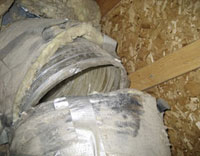
The Uniform Mechanical Code states that all duct work should be rugged enough to stay together and not leak. Support is a big part of durability, because ducts are not made to be structurally sound by themselves and will cause damage and leaks without proper support. Make sure you have the proper permits when you hire a Denver HVAC contractor to replace or repair your heating and air conditioning system.
A proper permit will protect you when your inspector finds shoddy ductwork. Often ductwork is overlooked by Denver air conditioning and heating installers, so more than likely, there will be some sort of problem. Specialty HVAC companies in Denver test commercial ductwork. They work with engineers to balance the design with the original HVAC parameters. For commercial HVAC jobs, the contractor will usually not receive full payment until the system passes these test. A good Colorado heating and AC contractor will not be hesitant about inspections and permits. If it is a good job, the inspector will validate your HVAC contractor's work.
If your inspector does not do a thorough job, consider hiring an independent HVAC contractor to inspect the work. In areas susceptible to flooding, the mechanical code asserts that the ducts be sealed from water. This ductwork is usually made of hard sheet metal sealed at all joints. Wet insulation will fall apart and expose ducts to moisture. In Denver HVAC systems that are wet can corrode and cause damage from mold an mildew. These problems can be harmful to your health so inspect your system and make sure there is a vapor barrier.
Do not make me reiterate: Duct tape is not for ducts. Duct tape is the number one sign of shoddy heating and air conditioning work. Duct tape specifically made for central air designs works O.K., but in reality, duct tape was not made for ducts and does not hold a seal for long enough. It was originally used in World War 2 to seal ammo containers. The name was changed to duct tape after the war to find a use for this handy tape. New HVAC certified duct tape should have an aluminum backing.
Wednesday, April 28, 2010
Is it really HVAC?

HVAC stands for Heating Ventilation and Air Conditioning. Any system that works to improve interior comfort can be considered HVAC. But if you want your Denver heating and air conditioning to work, it is best to consult a Colorado certified HVAC specialist. You can dramatically effect your energy bills by making sure your HVAC is up to par. Denver HVAC companies really make their money on big boxes, and medium and large office buildings where proper heating and air conditioning result in big savings on overhead.
The three functions of a Denver HVAC: heating, cooling and ventilation, became needs in the industrial revolution when people were crowded into factories and office buildings. Originally, these comforts were provided by a hodgepodge of fans, boilers and fireplaces. A proper Colorado HVAC provides comfort as well as clean air. Most Denver heating and cooling systems do not run under the strains of a full blown office space system, but a certified HVAC professional can still provide savings. For larger buildings, architects and engineers specifically design the heating and air conditioning systems to match the building and the HVAC to our Colorado weather. For it to be considered HVAC, it must be a truly unified system.
Heating is essential in Denver winters. Central heating consists of some sort of heating element like a boiler or furnace, a transport system to pull the heat into the room, and a thermostat to monitor temperature.
Unfortunately, air quality is going down, so in Denver ventilation systems are a must. Some construction or industrial sites need special ventilation to keep harmful fumes from workers. But even the average office worker wants clean air to be able to work properly.
Cooling is done by air conditioning except in very dry climates. Some homes in Denver use evaporative coolers, which cool through the natural power of water evaporation, and add moisture to the air.
Central air and heat pumps need a proper cooling charge. A certified Denver HVAC specialist should check your system for the proper charge. An incorrect amount of coolant will put a strain on your air conditioning or heat pump. Air flow out of the cooling system should also be optimized so it can go smoothly from your refrigerating element to the house.
Energy Star Qaulified HVAC

Heating and cooling account for more than half of the energy use in the average Denver home. You need heat to keep from freezing in Denver, and the piercing summer sun takes up money in cooling a Denver home. HVAC - Heating, Ventilation, and Air Conditioning is just what it says: the way you keep your home warm or cool. In a green state like Colorado, everyone is trying to do their part to reduce energy use... and save money. In Denver heating is a matter of survival, while few can give up air conditioning now. One way to keep Denver air conditioning costs down is to make sure your Denver HVAC system meets federal Energy Star guidelines.
These tips will not only lower your heating bills and emissions, they will also make your HVAC system work more effectively - and keep you comfortable all year.
The easiest, and often overlooked step is to replace your Denver HVAC air filters. Check your air filter every month, because especially in times of heavy use, Denver heating and air conditioning needs to work at optimal condition. Change your filter at least every 3 months. A dirty filter wastes energy because the HVAC needs more power to move the same amount of air through the clogged filter. Clean filters prevent dust and malfunctions to your heating system caused by dust. A dirty HVAC system can fail, and you do not want your heating in Colorado to fail during January.
Tune up your system. If you have a Denver HVAC contractor that you trust, calling them for a little tune-up is preventative maintenance. Your Colorado heating and air conditioning specialist should also install a programmable thermostat. These smart thermostats save you money and time over the year by shutting off when you are not home. If you are away from home at regular times, a programmed thermostat can save hundreds a year. Having the perfect Denver heating source means nothing if your HVAC ducts are not properly sealed. The ducts transfer all that precious warm or cold air to your room. Improperly sealed and insulated ducts can cost your upwards of a 20% increase in energy bills. Any Denver HVAC company worth its salt will seal your ducts and inspect them for free. Focus on sealing ducts that run through un-insulated areas like the attic, garage or crawlspace. Duct sealant and metal foil tape actually works much better than duct tape. If you want your Denver heating and air conditioning system to leak like a siv, use duct tape.
Your actual equipment should be Energy Star qualified. An old HVAC system in Colorado is probably costing you money. A professional Denver HVAC contractor can evaluate your system and see if upgrading part of it will be cost effective. Replacing old equipment with Energy Star certified HVAC hardware can save around $200 a year. Some of the main problems old or improperly designed Denver HVAC systems have are Low airflow, Improper charge, and Duct leakage.
Properly sized equipment will keep your system running efficiently. Too large a system will result in frequent on-off cycling. In Denver heating and air conditioning should not be on simultaneously! Incorrect sizing will also stress that expensive equipment your HVAC contractor installed.
Subscribe to:
Posts (Atom)


